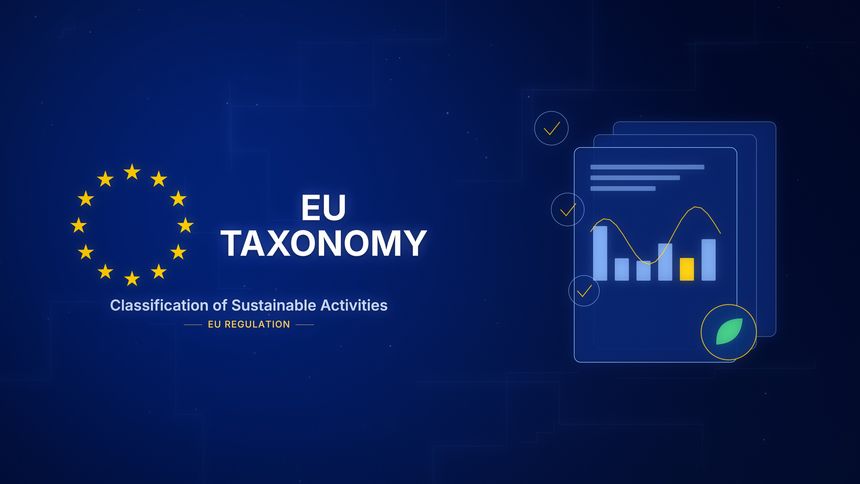
The European Commission has adopted two Delegated Regulations simplifying the EU Taxonomy's technical screening criteria.
The EU Taxonomy, which has been in place since 2020, establishes a technical screening criteria to specify the conditions that economic activities must meet to quality as sustainable. Whilst maintaining regulatory effectiveness, the adopted changes aim to make the technical criteria clearer and easier to apply, by removing unnecessary or duplicative requirements, aligning them with updated EU legislation and technological developments, and clarifying how companies can demonstrate compliance.
The adopted measures amend the Climate and Environmental Delegated Acts, as follows:
Commission Delegated Regulation amending Delegated Regulation (EU) 2021/2139 / Annex 1 and Annex 2 – Simplifies the technical screening criteria for economic activities contributing substantially to climate change mitigation and adaptation.
Commission Delegated Regulation amending Delegated Regulation (EU) 2023/2486 / Annex 1, Annex 2, Annex 3 and Annex 4 – Revises the criteria covering the four other environmental objectives: water and marine resources, circular economy, pollution prevention and control, and biodiversity and ecosystems.
The revisions include targeted simplifications to the Do No Significant Harm (DNSH) criteria, clearer requirements for demonstrating compliance, and adjustments to sector-specific requirements across most activities, including forestry, environmental protection, manufacturing, energy, transport and construction.
Alongside streamlining compliance reporting, clearer technical screening criteria could enable boards and executive teams to more effectively embed the Taxonomy into capital allocation decisions prior to commitment – a true test for these simplification measures will be how far they help channel capital toward environmentally sustainable activities and generate measurable improvements, while safeguarding the comparability and integrity of decision useful information.
The Commission consulted on the draft Delegated Regulations in March 2026 (see our earlier blog post).
Next steps
The revised delegated acts will now be transmitted to Parliament and Council for a four-month scrutiny period, extendable by two months. The co-legislators cannot amend the acts; they can only object to them.
Provided no objections, the delegated acts will be published in the Official Journal and enter into force 20 days later. They will apply from 1 January 2028. For financial years starting in 2027, companies can still choose to apply the current criteria (as they stand on 31 December 2027). In practice, the revised criteria will become mandatory from FY2028.
The Commission's press release, published on 26 November 2026, is available here.
Further reading
EU Omnibus Tracker: simplification of sustainability rules